616dvocab ids11.17mean input tokens13max input tokens256dz
Held-out exact reconstruction1.000
Also 1.000 on the decorrelated set.
ACTIVE PAPER PROJECT · 11 SEPTEMBER 2026
Understanding neuralese,
one sentence vector at a time.
A general testbed, a common method comparison, and two investigations of partial understanding.
Companion page to the manuscript appendix plan · written 12 September 2026 · all numbers are read from archived files; no model was loaded and no training was run.
Scope. This page documents how the small trained text autoencoders used as L2 substrates (PLAN_V2 §L2; experiment B2) were built, how much data they saw, and what "generalisation" means for them. It is an appendix: it supports the B2 rows of the shortfall table and the case-study provenance. It does not add a benchmark result. Every number carries its source path. Numbers computed on this box for this page (the corpus token counts of G.5) are marked as such and are reproducible from the listed script.
| name | objective | date | status | source |
|---|---|---|---|---|
| pilot v0 | surface → surface reconstruction; 3 syntactic frames | 2026-07-02 | superseded; 7,542,784 params, 58,765 steps, 194,730,362 tokens, 45 min, exact 1.000 | /data/research/benchmarks/night8/organism/PILOT_REPORT.md, organism/pilot_results/metrics.json |
| organism_v1 (this page) | surface paraphrase → canonical rendering of the meaning tuple | 2026-07-02 | the L2 substrate used in B2; d_z ∈ {256, 64}, seed 0, plus three d_z=64 seed replicates | /data/research/benchmarks/night8/organism_v1/V1_REPORT.md; seeds /data/research/benchmarks/night8/organism_v1_seeds/SEEDS_REPORT.md |
| organism_v2 | two-clause surface → computed canonical (sum of counts, sorted agents, categories) | 2026-07-02 | comparison rows only (G.4, G.6.4) | /data/research/benchmarks/night8/organism_v2/V2_REPORT.md |
The seed replicates reuse train_v1.py, corpus_v1.py, model.py byte-for-byte (diff against 4l:/workspace/HOME/guest/night8/organism_v1/ checked 12 September 2026: identical). Checkpoints live only on the GPU box: 4l:/workspace/HOME/guest/night8/organism_v1/run_dz{256,64}/{ckpt_best,ckpt_final}.pt and 4l:/workspace/HOME/guest/night8/organism_v1_seeds/run_seed{1,2,3}/ckpt_final.pt (30 MB each, no optimiser state).
Source: /data/research/benchmarks/night8/organism_v1/model.py, train_v1.py.
| component | value |
|---|---|
| vocabulary | 957 ids = 953 content types (exhaustively enumerated from the generator; no UNK possible) + <pad> <bos> <eos> <unk>; whitespace tokenisation |
| token embedding | 256-d, tied to the output projection (out.weight = tok_emb.weight) |
| positions | learned, separate encoder/decoder tables, max_len 24 |
| encoder | 4 × nn.TransformerEncoderLayer, d_model 256, 4 heads, FFN 1024, GELU, dropout 0.1 |
| bottleneck | masked mean-pool over encoder states → Linear(256 → d_z) = z; Linear(d_z → 256) = m |
| decoder | 4 × nn.TransformerDecoderLayer (same widths); m is the length-1 cross-attention memory and is added to every decoder token embedding; causal mask; greedy decoding, max 14 tokens |
| parameters | d_z=256: 7,761,664 · d_z=64: 7,663,168 (metrics.json:params; count de-duplicates the tied weight) |
| sequence caps | surface ≤ 20 tokens (corpus max 18), canonical ≤ 13 (corpus max 11) |
Objective. Paraphrase-canonicalisation: encode a surface sentence, decode the fixed-order canonical rendering of the same meaning tuple — AGENT [not] VERB[tense] [COUNT as digits] PATIENT ADJS [in the LOC] . — with canonical synonyms and explicit not. Loss is token cross-entropy on the canonical stream (pad ignored, no label smoothing), teacher-forced. Surface ≠ canonical for 0.99368 of training pairs (V1_REPORT §1; recomputed here 0.993963, G.5). The canonical form has an exact inverse parser (corpus_v1.parse), which is what every "round-trip" number below uses.
Optimiser and schedule (train_v1.py defaults, unchanged in every run):
| setting | value |
|---|---|
| optimiser | AdamW, lr 3e-4, weight decay 0.01, gradient clip 1.0 |
| schedule | linear warm-up 500 steps, cosine to a 5 % floor over a 40,000-step horizon, then constant at the floor (1.5e-5) |
| batch | 256 pairs, reshuffled each pass over the 2,000,000 pre-tokenised pairs |
| budget | wall-clock: 90 min (seed 0 runs), 35 min (seed 1–3 replicates); no step target |
| evaluation | every 2,000 steps on three fixed sets: in-distribution 3,000 (seed 8801), held-out role combos 1,500 (seed 8802), decorrelated 1,500 (seed 8803) |
| checkpointing | ckpt_best.pt overwritten when in-distribution exact match strictly improves; ckpt_final.pt at the deadline |
| early stopping | none in v1 — the run ends at the wall-clock deadline. v2 (train_v2.py) adds a rule: stop when in-distribution exact match has been 1.000 at every evaluation for 20 min (--plateau_minutes 20) |
Hardware: one RTX A4000 per run on the 4l box (NVML broken; device liveness verified by a trial matmul; memory read from torch.cuda.max_memory_allocated).
Source: /data/research/benchmarks/night8/organism_v1/corpus_v1.py (constants and sample_factors), ORGANISM_V1_SPEC.md, V1_REPORT §1.
Meaning factors (all logged; all required by the canonical target):
| factor | cardinality | sampling |
|---|---|---|
| verb class | 4 (pursuit, social, handling, perception) | social p=.35, others .65/3 each |
| verb | 40 (10 per class) | Zipfian within class |
| agent | 100 names (one pool, 50 female + 50 male) | Zipfian |
| patient | 80 object concepts (8 categories × 10) or a person from the same 100-name pool (≠ agent) when the verb is social → two-person events, 0.34934 of the corpus | Zipfian |
| count | 2–99 (98 values), digits in the canonical form | present p=.6, object patients only |
| adjectives | 0–2 from 30, canonical-sorted | 0 / 1 / 2 with p .45 / .35 / .20; Zipfian |
| location | 40 (4 classes × 10) | present p=.5; class = verb class with p=.9 (decorrelate=True → uniform) |
| tense | past / present | uniform |
| negation | binary | p=.15 |
String-inert factors (logged, never rendered; theorem-grade absent): mood (3), narrator (20).
Surface latents (change the surface, not the target): paraphrase family (9: active .18, passive .15, cleft .10, fronted-locative .10 [needs a location], nominalisation .10, there-construction .10, question .04, topicalisation .13, pseudo-cleft .10), verb synonym (2–3 per concept), object synonym (2 per concept), number style (digit / word), filler adverb (8, p=.3), locative preposition (3).
Corpus: 2,000,000 (surface, canonical, factors) triples, sample_pairs(2_000_000, seed=0, split="train"), generated in-process (18.2 s on 4l, 19.5 s here). Unique surfaces 1,964,397 (metrics.json:train_unique_surface; recomputed identically in G.5). Surface length mean 9.80 / max 18; canonical mean 6.79 / max 11.
Synonyms, number style, filler adverb and locative preposition change the wording.
many possible sentencesFixed field order, canonical synonyms, digits and explicit negation.
one parseable targetHeld-out split rule. An ordered two-person combination (verb, agent, patient) is held out iff the first byte of md5("verb|agent|patient") is divisible by 20 (≈ 5 % of ordered combos). split="train" never emits a held-out combination; split="heldout" emits only those. Leakage in both directions was asserted 0 on 20,000 / 2,000 samples at build time (V1_REPORT §1). Because the rule hashes the ordered triple, the reverse role assignment of a held-out combination may occur in training.
Sources: run_dz256/metrics.json, run_dz64/metrics.json under /data/research/benchmarks/night8/organism_v1/; figures/organisms/seed{1,2,3}_metrics.json (verbatim copies of 4l:/workspace/HOME/guest/night8/organism_v1_seeds/run_seed{1,2,3}/metrics.json, SHA-256 in figures/organisms/SHA256SUMS); /data/research/benchmarks/night8/organism_v2/run_{sem_dz64,sem_dz256,recon_dz64}/metrics.json. Derived columns: tokens/param = tokens_seen / params; epochs = steps × 256 / 2,000,000.
"Tokens seen" is train_v1.py's counter (line 177): non-pad source tokens plus non-pad decoder-input tokens per pair. The decoder input is <bos> + canonical + <eos> with its last column dropped, so <eos> is counted for every item except the batch-longest ones. Per pair this is 18.57 tokens (544,050,648 / (114,440 × 256)); content tokens without <bos>/<eos> are 16.59 per pair (G.5).
| checkpoint | d_z | seed | params | steps | tokens seen | tokens / param | epochs | wall-clock | tokens / s | peak GPU MB | stop reason |
|---|---|---|---|---|---|---|---|---|---|---|---|
organism_v1 run_dz256 |
256 | 0 | 7,761,664 | 114,440 | 544,050,648 | 70.1 | 14.65 | 5,400 s | 100,749 | 803 | 90-min budget |
organism_v1 run_dz64 |
64 | 0 | 7,663,168 | 110,274 | 524,244,249 | 68.4 | 14.12 | 5,400 s | 97,082 | 802 | 90-min budget |
organism_v1_seeds run_seed1 |
64 | 1 | 7,663,168 | 45,628 | 216,914,120 | 28.3 | 5.84 | 2,100 s | 103,291 | 807 | 35-min budget |
organism_v1_seeds run_seed2 |
64 | 2 | 7,663,168 | 45,369 | 215,748,897 | 28.2 | 5.81 | 2,100 s | 102,737 | 809 | 35-min budget |
organism_v1_seeds run_seed3 |
64 | 3 | 7,663,168 | 45,273 | 215,223,299 | 28.1 | 5.79 | 2,100 s | 102,487 | 802 | 35-min budget |
organism_v2 run_sem_dz64 (comparison) |
64 | 0 | 7,608,384 | 54,000 | 382,082,514 | 50.2 | 6.91 | 3,131 s | 122,030 | 949 | 100 %-exact plateau 20 min |
organism_v2 run_sem_dz256 (comparison) |
256 | 0 | 7,706,880 | 52,000 | 367,935,409 | 47.7 | 6.66 | 2,997 s | 122,771 | 952 | 100 %-exact plateau 20 min |
organism_v2 run_recon_dz64 (surface-reconstruction twin) |
64 | 0 | 7,608,384 | 68,000 | 568,973,540 | 74.8 | 8.70 | 5,405 s | 105,273 | 1,219 | 90-min budget |
Time to ceiling (in-distribution exact match, evaluations every 2,000 steps; from eval_log): first ≥ 0.99 at step 10,000 / 8,000 / 10,000 / 10,000 / 10,000 and first 1.000 at step 26,000 / 26,000 / 28,000 / 26,000 / 30,000 for dz256, dz64, seed1, seed2, seed3. Small dips (≥ 0.9993) occur between the first 1.000 and step 40,000; after step 40,000 every evaluation on all three splits is 1.000 for all five runs (checked from the same files). The seed 0 runs therefore spent roughly 65 of their 90 minutes on a flat plateau; the 35-min replicates stop after about 10 min of plateau (SEEDS_REPORT §Setup). v2's rows are included because they are the only runs of this family with a rule-based stop; their tokens/param (48–50) is where the plateau rule cuts the same schedule.
Computed 12 September 2026 on this box by /data/research/tae-interp/neuralese-paper/corpus_token_stats.py (CPU only; no torch; the Vocab class is executed from the archived model.py), output figures/organisms/corpus_token_stats.json, log figures/organisms/corpus_token_stats.log. The corpus is regenerated with the archived corpus_v1.sample_pairs(2_000_000, seed, split="train"), the exact call in train_v1.py. Check: the recomputed unique-surface count for seed 0 equals the logged 1,964,397; seeds 1–3 reproduce their logged 1,964,165 / 1,964,356 / 1,963,945. Generation took about 20 s per seed; no sub-sampling was needed.
(a) Tokens in the de-duplicated corpus, seed 0. Every surface string maps to exactly one canonical string, so unique (surface, canonical) pairs = unique surfaces = 1,964,397 (unique canonicals: 1,702,567 — different paraphrases of the same meaning tuple share a target).
| quantity (seed 0 corpus) | tokens | per param, d_z=256 (7,761,664) | per param, d_z=64 (7,663,168) |
|---|---|---|---|
| one pass over the 2,000,000 pairs, content tokens (surface + canonical) | 33,175,564 | 4.27 | 4.33 |
one pass, train_v1.py accounting (+ <bos> + <eos> per pair; upper bound) |
37,175,564 | 4.79 | 4.85 |
| unique (surface, canonical) pairs, content tokens | 32,786,808 | 4.22 | 4.28 |
unique pairs, train_v1.py accounting |
36,715,602 | 4.73 | 4.79 |
| (b) unique surface strings, source tokens only | 19,361,168 | 2.49 | 2.53 |
Consistency check: one pass under the train_v1.py accounting (37,175,564) × 14.648 passes = 544.6 M, against the logged 544,050,648 tokens seen (difference 0.1 %, the dropped <eos> of the batch-longest items).
Tokens seen vs. non-repeated tokens.
| checkpoint | tokens seen / param | unique-pair tokens / param (train_v1 accounting) |
ratio (≈ passes over the unique corpus) | epochs from steps |
|---|---|---|---|---|
| dz256 seed 0 | 70.1 | 4.73 | 14.8 | 14.65 |
| dz64 seed 0 | 68.4 | 4.79 | 14.3 | 14.12 |
| dz64 seed 1 | 28.3 | 4.79 | 5.91 | 5.84 |
| dz64 seed 2 | 28.2 | 4.79 | 5.87 | 5.81 |
| dz64 seed 3 | 28.1 | 4.79 | 5.86 | 5.79 |
The 70 tokens/parameter headline is therefore about 4.7 distinct tokens per parameter seen roughly 15 times each; the replicates saw the same 4.7 distinct tokens about 6 times each and reach the same 1.000 finals (G.6).
(c) Distinct token n-grams, seed 0 corpus (a diversity measure; counted within sequences after the 20/13 caps):
| n | surface (source) | canonical (target) | either |
|---|---|---|---|
| 1 | 953 | 432 | 953 |
| 2 | 131,187 | 35,034 | 141,893 |
| 3 | 1,448,575 | 968,815 | 2,354,793 |
| 4 | 3,872,236 | 2,442,890 | 6,278,920 |
For scale: the source side has 0.50 distinct 4-grams per parameter (d_z=256), and the whole canonical side uses 432 of the 953 content types (names, canonical lemmas in two tenses, digits, canonical nouns, adjectives, locations, not, in, the, .).
Seeds 1–3 (same generator, seed=1,2,3; the seed also sets weight init and batch order, SEEDS_REPORT §Setup):
| seed | unique surfaces | unique pairs, content tokens | unique surface, source tokens | distinct source 4-grams |
|---|---|---|---|---|
| 1 | 1,964,165 | 32,783,930 | 19,359,409 | 3,876,201 |
| 2 | 1,964,356 | 32,797,637 | 19,370,573 | 3,872,341 |
| 3 | 1,963,945 | 32,781,640 | 19,360,739 | 3,875,127 |
Definition used on this page. For these models "generalisation" means correct canonicalisation of sentences whose factor combination was not in the 2,000,000 training pairs, inside a closed synthetic vocabulary of 953 types and nine paraphrase families. It is not transfer to open-domain text, to unseen words, or to unseen constructions. Every split below is drawn from the same generator; only the combination rule differs.
Sources: run_dz{256,64}/metrics.json:final, summary_tables.md, V1_REPORT §2; seeds from figures/organisms/seed{1,2,3}_metrics.json:final.
| split | what is new relative to training | n | exact canonical match, dz256 / dz64 / seed1 / seed2 / seed3 | parse-fail | role-binding accuracy (two-person items) |
|---|---|---|---|---|---|
| in-distribution | fresh sample from the training distribution (seed 8801); string collision rate with the training set was not measured | 3,000 | 1.000 / 1.000 / 1.000 / 1.000 / 1.000 | 0.000 all | 1.000 all (n=1,017) |
| held-out role combos | ordered (verb, agent, patient) two-person triples never sampled in training (md5 rule, §G.3) | 1,500 | 1.000 / 1.000 / 1.000 / 1.000 / 1.000 | 0.000 all | 1.000 all (n=1,500) |
| decorrelated | location class drawn uniformly, breaking the p=.9 verb-class ↔ location-class alignment of training | 1,500 | 1.000 / 1.000 / 1.000 / 1.000 / 1.000 | 0.000 all | 1.000 all (n=525) |
Per-factor round-trip (parse of the greedy canonical output vs. logged factors) is 1.000 for all eight meaning factors — verb, agent, patient, count, adjs, location, tense, negation — on all three splits, for all five checkpoints (final.*.per_factor in each metrics.json; summary_tables.md "Per-meaning-factor round-trip"). Token accuracy is 1.000 on every final split.
The held-out-combo split is the compositional certificate of the v1 report: those exact role assignments were never seen, yet agent and patient are placed correctly in the canonical order. Its limits: the reverse assignment may have been seen; every name, verb and construction was seen many times; and the split is 5 % of two-person triples, not a held-out name or verb.
A weaker out-of-DGP datum exists as a by-product of the M2b battery (V1_REPORT §3, M2b note): verb toggles applied to unconstrained backgrounds create verb-class × patient-type combinations that the generator never produces (e.g. a social verb with a counted object patient); base round-trip on those sentences is 0.961 (dz256) and 0.977 (dz64), versus 1.000 on in-DGP backgrounds. This is the only measurement of behaviour outside the generator's support, and it was not designed as one.
Source: /data/research/benchmarks/night8/organism_v1_seeds/SEEDS_REPORT.md and the seed metrics.json files. All three replicates reach 1.000 on every split, factor and binding measure with 5.8 epochs (G.4). What varies across seeds is not the behavioural ceiling but the certification tier of weak surface latents (loc_prep, num_style, patient_syn, verb_syn flip between P_NONLINEAR_ONLY / P_LINEAR / NO_GT; SEEDS_REPORT §1); the eight meaning factors and binding are P_LINEAR in all seeds.
Source: /data/research/tae-interp/neuralese-paper/experiments/B2-organism-shortfall/results/TABLE.md (coverage lines and READ tables per tag; "Seed spread" section), results/read.json, NOTES.md (stimulus design). Stimuli: the 100 names are shuffled with seed 20260912; TRAIN uses the first 60, TEST the last 40; two-person items draw both roles from the split's names; 300 TEST items per factor; backgrounds sampled with split="any", so 46 of the 300 ROLE TEST items fall on training-held-out (verb, agent, patient) combos. "Certified" = the decoder parses both the base and the counterfactual item to their logged factors (parse(D(z_src)) and parse(D(z_tgt)) exact). "Lens" = accuracy of reading the factor off the decoder's own output; it is the READ ceiling.
| checkpoint | coverage: ROLE / POLARITY / TENSE / COUNT / CONTENT (of 300 each) | canonical re-encode round-trip | lens (READ ceiling): role_id / POL / TENSE / COUNT / CONTENT |
|---|---|---|---|
dz256 (ckpt_best) |
0.990 / 1.000 / 0.993 / 0.993 / 0.997 | 0.970 | 0.995 / 1.000 / 1.000 / 1.000 / 0.998 |
dz64 (ckpt_best) |
1.000 / 1.000 / 0.997 / 0.997 / 1.000 | 0.983 | 1.000 / 1.000 / 1.000 / 1.000 / 1.000 |
dz64 seed 1 (ckpt_final) |
1.000 / 1.000 / 1.000 / 1.000 / 1.000 | 0.997 | 1.000 / 1.000 / 1.000 / 1.000 / 1.000 |
| dz64 seed 2 | 1.000 / 1.000 / 1.000 / 1.000 / 1.000 | 0.997 | 1.000 / 1.000 / 1.000 / 1.000 / 1.000 |
| dz64 seed 3 | 1.000 / 1.000 / 1.000 / 1.000 / 1.000 | 0.990 | 1.000 / 1.000 / 1.000 / 1.000 / 1.000 |
| untrained copy, d_z=256 (control) | 0.000 / 0.000 / 0.000 / 0.000 / 0.000 | 0.000 | 0.000 on every cell |
| untrained copy, d_z=64 (control) | 0.000 / 0.000 / 0.000 / 0.000 / 0.000 | 0.000 | 0.000 on every cell |
Reading: on names the models never saw in the TRAIN half of the stimulus set (but did see in pre-training) the decoder certifies 297–300 of 300 items per factor, and reading each factor off the decoder output is at ceiling (0.995–1.000). The untrained same-architecture copies certify 0 items and have a lens of 0.000 (their decodes never parse), which is the intended null: coverage is a property of training, not of the parser. Note the asymmetry inside the untrained rows: linear probes on the untrained z still read POLARITY at 0.998 / 0.990 and COUNT at 0.768 / 0.403 (TABLE.md, untrained READ), so "readable from z" and "certified through the decoder" are different endpoints, as the manuscript's editorial commitment 5 requires.
Seed spread of the READ cells (fraction of lens; four d_z=64 models: seed 0 at 90 min and seeds 1–3 at 35 min; TABLE.md "Seed spread"):
| cell (linear probe) | dz64 | seed 1 | seed 2 | seed 3 | mean ± sd [min, max] |
|---|---|---|---|---|---|
| ROLE:role_id | 1.00 | 1.00 | 1.00 | 1.00 | 1.000 ± 0.000 [1.00, 1.00] |
| POLARITY | 1.00 | 1.00 | 1.00 | 1.00 | 1.000 ± 0.000 [1.00, 1.00] |
| TENSE | 1.00 | 1.00 | 1.00 | 1.00 | 1.000 ± 0.001 [1.00, 1.00] |
| COUNT | 0.95 | 0.97 | 0.94 | 0.91 | 0.945 ± 0.023 [0.91, 0.97] |
| CONTENT | 0.99 | 1.00 | 0.99 | 0.99 | 0.995 ± 0.003 [0.99, 1.00] |
The 98-way COUNT read is the one cell with visible seed variance (0.91–0.97 of ceiling) and the one where a 35-min replicate is not systematically better or worse than the 90-min reference. ROLE-XC (train on active renderings, test on passives) stays at 1.000 for role_id across all four models; the binary role_bin label reads at chance (0.47–0.53) in every model — the TRACE caveat that a designated-A binary label confounds binding with a name-comparison nonlinearity (NOTES.md, READ cells).
Source: /data/research/benchmarks/night8/organism_v2/summary_tables.md "Training" and "TOTAL accuracy by magnitude"; V2_REPORT §2–3. Same architecture, corpus size and schedule; the canonical target is computed (TOTAL = count1 + count2 as digit tokens, agents sorted alphabetically, together iff the two agents are equal).
| split | new relative to training | sem d_z=64 | sem d_z=256 | recon twin d_z=64 |
|---|---|---|---|---|
| in-distribution | fresh sample | 1.000 | 1.000 | 0.9997 |
| decorrelated | location class uniform | 1.000 | 1.000 | 1.000 |
| held-out agent pairs | unordered name pairs with md5 % 20 == 0 (incl. self-pairs) never in training | 0.683 | 0.685 | 0.995 |
| — distinct pairs only (n from 1,500) | 0.987 | 0.991 | — | |
— held-out self-pairs (A together) |
0.000 | 0.000 | — | |
| held-out totals 80–98 | each count ≤ 49 seen, the sum never | 0.000 | 0.000 | 1.000 |
| — ones digit of the sum correct | 0.454 | 0.911 | — | |
| — decoded tens digit = 7 (training maximum band) | 0.993 | 0.993 | — |
The same substrate family therefore shows both faces: v1 generalises across every combination it was tested on; v2 generalises alphabetical ordering to never-seen pairs (0.99) and the carry rule of addition (ones digit 0.91 at d_z=256) but memorises the magnitude support (tens digit clamps at the training maximum, 0.993 of held-out totals decode as 7x) and does not generalise the equality test to held-out self-pairs (0.000). The recon twin, trained on the same data to copy the surface, has no such failures (0.995 / 1.000) because its target requires no computation. Generalisation here is a property of the target function, not of the encoder or the corpus.
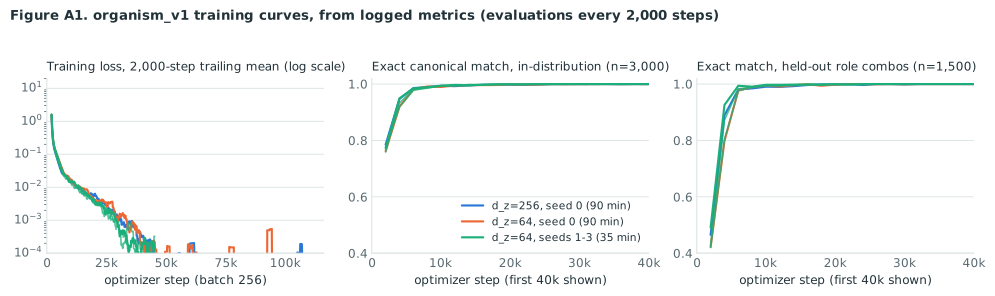
Rendered by make_organism_figure.py from the five metrics.json files (loss logged every 100 steps to four decimals, shown as a 2,000-step trailing mean on a log axis; exact match at the 2,000-step evaluations, first 40,000 steps shown; after step 40,000 every evaluation on all three splits is 1.000 for all five runs). Plotted values are frozen in figures/organisms/figA1_data.json. Loss values below 1e-4 are floor-rounded in the logs. No per-step validation loss was logged, and no curves exist for the M1/M2 battery quantities.
These organisms are converged solutions of a small closed problem: 7.7 M parameters, 953 vocabulary types, about 4.7 distinct training tokens per parameter seen 6–15 times, and a target with an exact parser. They reach 1.000 on every behavioural measure the archive defines, including the two held-out splits, and B2 finds decoder certification at 0.99–1.00 and READ at ceiling on agent-disjoint items with seed spread at the third decimal except for the 98-way count read. Their value to TAE-Bench is exactly that: a substrate on which the ceiling is known to be 1.0, the factor labels are exact, and an untrained copy certifies 0 items, so any shortfall in a READ or EDIT cell is attributable to the interpretation method rather than to the substrate. The limits are equally definite. Generalisation was only ever tested inside the generator's support (novel factor combinations, never novel words, families or lengths); the one out-of-support datum (0.96–0.98 on verb-class × patient-type combinations the DGP never emits) was incidental; in-distribution evaluation items were not checked for string collisions with the training set; and v2 shows that the same recipe memorises rather than generalises as soon as the target requires magnitude extrapolation or an equality test on held-out pairs. Nothing on this page licenses a claim about SONAR-scale encoders or natural text. [needs to be improved] Before submission, add a train/eval string-collision count for the in-distribution split and a held-out-name split for v1 (the B2 stimulus split holds names out of the probe's training set, not of the organism's).
/data/research/tae-interp/neuralese-paper/APPENDIX_ORGANISMS.md → appendix_organisms.html (built by build.py).corpus_token_stats.py → figures/organisms/corpus_token_stats.json and .log.make_organism_figure.py → figures/figA1-organism-training.{svg,png}, data figures/organisms/figA1_data.json.figures/organisms/seed{1,2,3}_metrics.json, figures/organisms/SEEDS_REPORT.md (from 4l; also at /data/research/benchmarks/night8/organism_v1_seeds/SEEDS_REPORT.md)./data/public/safety/research/tae-interp/neuralese-paper/.